

Golden Rule, 1961, by Norman Rockwell (1894-1978). Oil on canvas, 44 1/2” x 39 1/2”. Story illustration for The Saturday Evening Post, April 1, 1961. The painting hangs in the United Nations New York City, NY headquarters.
Golden Rule, 1961, by Norman Rockwell (1894-1978). Oil on canvas, 44 1/2” x 39 1/2”. Story illustration for The Saturday Evening Post, April 1, 1961. The painting hangs in the United Nations New York City, NY headquarters.
Filed under Uncategorized
America, the free and the brave.
America, land of the brutish, home- grown, domestic and murderous savage terrorist.
Always the weak pathetic excuses of lone wolf, insane, put-upon, downtrodden, woe-is me murdering savage.
No, just another example of a continuing long, very long line, of domestic terrorist.
America, land of race hate, venom, viciousness, barbaric brutality, perversions, and abominations.
Nikita Khrushchev said it wrong when he was said to have stated, “We will bury you.”
No.
He should have stated, “You, will bury yourselves.” Although later, he is said to have stated, “Your own working class will bury you.” Whatever has been stated, America is tearing itself to pieces from within, has been for over four centuries, and this bloodlust and destruction is not something that has been done, nor is being done, by Black Americans. We are not the terrorists of this so-called nation. We never have been. Murdering savages like Stephen Paddock, Scott Ostrem, Devin Patrick Kelly——are just the oozing, pus-filled sores of racist domestic terrorism on which this nation is founded, running sores that are bursting open and flooding their savagery, spoken (and unspoken), from sea to shining sea.
They are not the first, nor will they be the last.
They never have been, nor never will be.
America, the Great Whore of Babylon is unraveling. The time has come. The Angel of Death is passing over America.
Babylon is falling.
1. Hail the day so long expected!
Hail the year of full release!
Zion’s walls are now erected,
And her watchmen publish peace:
From the distant coasts of Shinar,
The shrill trumpet loudly roars
Refrain: Babylon is fallen! is fallen! is fallen!
Babylon is fallen to rise no more.2. Hark, and hear her people crying,
“See the city disappear!
Trade and traffic all are dying!
Lo, we sink and perish here!”
Sailors who have bought her traffic,
Crying from her distant shore,
Refrain3. All her merchants cry with wonder,
“What is this that’s come to pass?”
Murm’ring like the distant thunder
Crying out, Alas! Alas!
Swell the sound, ye kings and nobles!
Priests and people, rich and poor!
Refrain4. Lo, the captives are returning!
Up to Zion see them fly!
While the smoke of Babel’s burning
Rolls across the darken’d sky!
Days of mourning now are ended,
Years of bondage now are o’er,
Refrain5. Zion’s children raise your voices,
And the joyful news proclaim!
How the heavenly host rejoices!
Shout and echo back the same!
See the ancients of the city,
Terrify’d at the uproar!
Refrain6. Tune your harps, ye heavenly choir!
Shout, ye foll’wers of the Lamb!
See the city all on fire!
Clap your hands and blow the flame!
Now’s the day of compensation
On the scarlet colour’d whore;
Refrain
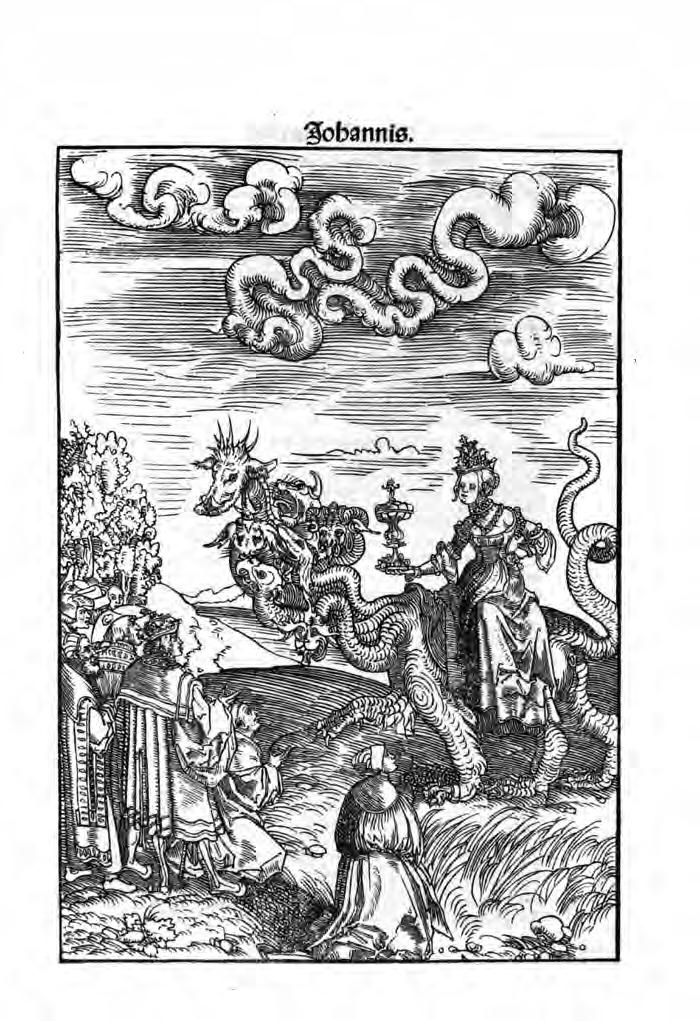
Whore of Babylon wearing the papal tiara from a woodcut in Luther Bible.
The Whore of Babylon by Lucas Cranach the Elder in the September, 1522 publication of Luther’s translation of the New Testament.
Filed under Uncategorized
FATS DOMINO, EARLY ROCK ‘N’ ROLLER WITH A BOOGIE-WOOGIE PIANO

Fats Domino, the New Orleans rhythm-and-blues singer whose two-fisted boogie-woogie piano and nonchalant vocals, heard on dozens of hits, made him one of the biggest stars of the early rock ’n’ roll era, died on Tuesday at his home in Harvey, La., across the Mississippi River from New Orleans. He was 89.
His death was confirmed by the Jefferson Parish coroner’s office.
Mr. Domino had more than three dozen Top 40 pop hits through the 1950s and early ’60s, among them “Blueberry Hill,” “Ain’t It a Shame” (also known as “Ain’t That a Shame,” which is the actual lyric), “I’m Walkin’,” “Blue Monday” and “Walkin’ to New Orleans.” Throughout he displayed both the buoyant spirit of New Orleans, his hometown, and a droll resilience that reached listeners worldwide.
He sold 65 million singles in those years, with 23 gold records, making him second only to Elvis Presley as a commercial force. Presley acknowledged Mr. Domino as a predecessor.
“A lot of people seem to think I started this business,” Presley told Jet magazine in 1957. “But rock ’n’ roll was here a long time before I came along. Nobody can sing that music like colored people. Let’s face it: I can’t sing it like Fats Domino can. I know that.”
Rotund and standing 5 feet 5 inches — he would joke that he was as wide as he was tall — Mr. Domino had a big, infectious grin, a fondness for ornate, jewel-encrusted rings and an easygoing manner in performance; even in plaintive songs his voice had a smile in it. And he was a master of the wordless vocal, making hits out of songs full of “woo-woos” and “la-las.”

Working with the songwriter, producer and arranger David Bartholomew, Mr. Domino and his band carried New Orleans parade rhythms into rock ’n’ roll and put a local stamp on nearly everything they touched, even country tunes like “Jambalaya” or big-band songs like “My Blue Heaven” and “When My Dreamboat Comes Home.”
‘A Good Ear for Catchin’ Notes’
Antoine Dominique Domino Jr. was born on Feb. 26, 1928, the youngest of eight children in a family with Creole roots. He grew up in the Ninth Ward of New Orleans, where he spent most of his life.
Music filled his life from the age of 10, when his family inherited an old piano. After his brother-in-law Harrison Verrett, a traditional-jazz musician, wrote down the notes on the keys and taught him a few chords, Antoine threw himself at the instrument — so enthusiastically that his parents moved it to the garage.
He was almost entirely self-taught, picking up ideas from boogie-woogie masters like Meade Lux Lewis, Pinetop Smith and Amos Milburn. “Back then I used to play everybody’s records; everybody’s records who made records,” he told the New Orleans music magazine Offbeat in 2004. “I used to hear ’em, listen at ’em five, six, seven, eight times and I could play it just like the record because I had a good ear for catchin’ notes and different things.”
He attended the Louis B. Macarty School but dropped out in the fourth grade to work as an iceman’s helper. “In the houses where people had a piano in their rooms, I’d stop and play,” he told USA Today in 2007. “That’s how I practiced.”
In his teens, he started working at a club called the Hideaway with a band led by the bassist Billy Diamond, who nicknamed him Fats. Mr. Domino soon became the band’s frontman and a local draw.
“Fats was breaking up the place, man,” Mr. Bartholomew told The Cleveland Plain Dealer in 2010. “He was singing and playing the piano and carrying on. Everyone was having a good time. When you saw Fats Domino, it was ‘Let’s have a party!’ ”
He added: “My first impression was a lasting impression. He was a great singer. He was a great artist. And whatever he was doing, nobody could beat him.”

CreditAgence France-Presse — Getty Images
In 1947 Mr. Domino married Rosemary Hall, and they had eight children, Antoine III, Anatole, Andre, Antonio, Antoinette, Andrea, Anola and Adonica. His wife died in 2008. A complete list of survivors was not immediately available.
In 1949 Mr. Bartholomew brought Lew Chudd, the owner of Imperial Records in Los Angeles, to the Hideaway. Mr. Chudd signed Mr. Domino on the spot, with a contract, unusual for the time, that paid royalties rather than a one-time purchase of songs.
Immediately, Mr. Domino and Mr. Bartholomew wrote “The Fat Man,” a cleaned-up version of a song about drug addiction called “Junkers Blues,” and recorded it with Mr. Bartholomew’s studio band. By 1951 it had sold a million copies.
Mr. Domino’s trademark triplets, picked up from “It’s Midnight,” a 1949 record by the boogie-woogie pianist and singer Little Willie Littlefield, appeared on his next rhythm-and-blues hit, “Every Night About This Time.” The technique spread like wildfire, becoming a virtual requirement for rock ’n’ roll ballads.
“Fats made it popular,” Mr. Bartholomew told Rick Coleman, the author of “Blue Monday: Fats Domino and the Lost Dawn of Rock ’n’ Roll” (2006). “Then it was on every record.”
In 1952, on a chance visit to Cosimo Matassa’s recording studio in New Orleans, Mr. Domino was asked to help out on a recording by a nervous teenager named Lloyd Price. Sitting in with Mr. Bartholomew’s band, he came up with the memorable piano part for “Lawdy Miss Clawdy,” one of the first rhythm-and-blues records to cross over to a pop audience
Through the early 1950s Mr. Domino turned out a stream of hits, taking up what seemed like permanent residence in the upper reaches of the R&B charts. His records began reaching the pop charts as well.
In that racially segregated era, white performers used his hits to build their careers. In 1955, “Ain’t It a Shame” became a No. 1 hit for Pat Boone as “Ain’t That a Shame,” while Domino’s arrangement of a traditional song, “Bo Weevil,” was imitated by Teresa Brewer.
Mr. Domino’s appeal to white teenagers broadened as he embarked on national tours and appeared with mixed-race rock ’n’ roll revues like the Moondog Jubilee of Stars Under the Stars, presented by the disc jockey Alan Freed at Ebbets Field in Brooklyn. Appearances on national television, on Steve Allen and Ed Sullivan’s shows, put him in millions of living rooms.
He did not flaunt his status as an innovator, or as an architect of a powerful cultural movement.
“Fats, how did this rock ’n’ roll all get started anyway?” an interviewer for a Hearst newsreel asked him in 1957. Mr. Domino answered: “Well, what they call rock ’n’ roll now is rhythm and blues. I’ve been playing it for 15 years in New Orleans.”
At a news conference in Las Vegas in 1969, after resuming his performing career, Elvis Presley interrupted a reporter who had called him “the king.” He pointed to Mr. Domino, who was in the room, and said, “There’s the real king of rock ’n’ roll.”
Mr. Domino had his biggest hit in 1956 with his version of “Blueberry Hill,” a song that had been recorded by Glenn Miller’s big band in 1940. It peaked at No. 2 on the pop charts and sold a reported three million copies.
“I liked that record ’cause I heard it by Louis Armstrong and I said, ‘That number gonna fit me,’ ” he told Offbeat. “We had to beg Lew Chudd for a while. I told him I wasn’t gonna make no more records till they put that record out. I could feel it, that it was a hit, a good record.”
He followed with two more Top Five pop hits: “Blue Monday” and “I’m Walkin’,” which outsold the version recorded by Ricky Nelson.
“I was lucky enough to write songs that carry a good beat and tell a real story that people could feel was their story, too — something that old people or the kids could both enjoy,” Mr. Domino told The Los Angeles Times in 1985.

Mr. Domino performed in 1950s movies like “Shake, Rattle and Rock,” “The Big Beat” (for which he and Mr. Bartholomew wrote the title song) and “The Girl Can’t Help It.” In 1957, he toured for three months with Chuck Berry, Clyde McPhatter, the Moonglows and others.
Well into the early 1960s, Mr. Domino continued to reach both the pop and rhythm-and-blues charts with songs like “Whole Lotta Lovin’,” “I’m Ready,” “I’m Gonna Be a Wheel Someday,” “Be My Guest,” “Walkin’ to New Orleans” and “My Girl Josephine.”
He toured Europe for the first time in 1962 and met the Beatles in Liverpool, before they were famous. His contract with Imperial ended in 1963, and he went on to record for ABC-Paramount, Mercury, Broadmoor, Reprise and other labels.
His last appearance in the pop Top 100 was in 1968, with a version of “Lady Madonna,” the Beatles song that had been inspired by Mr. Domino’s piano-pounding style. In 1982, he had a country hit with “Whiskey Heaven.”
Although he was no longer a pop sensation, Mr. Domino continued to perform worldwide and appeared for 10 months a year in Las Vegas in the mid-1960s. On tour, he would bring his own pots and pans so he could cook.
His life on the road ended in the early 1980s, when he decided that he did not want to leave New Orleans, saying it was the only place where he liked the food.
He went on to perform regularly at the New Orleans Jazz and Heritage Festival, and in 1987 Jerry Lee Lewis and Ray Charles joined him for a Cinemax special, “Fats Domino and Friends.” He released a holiday album, “Christmas Is a Special Day,” in 1993.

Reclusive and notoriously resistant to interview requests, Mr. Domino stayed home even when he received a lifetime achievement Grammy Award in 1987. (He did travel to New York when he was inducted into the Rock & Roll Hall of Fame in 1986 as one of its first members, although he did not take part in the jam session that concluded the ceremony.) In 1999, when he was awarded the National Medal of Arts, he sent his daughter Antoinette to the White House to pick up the prize.
He even refused to leave New Orleans when Hurricane Katrina devastated the city on Aug. 29, 2005, remaining at his flooded home — he was living in the Lower Ninth Ward then — until he was rescued by helicopter on Sept. 1.
“I wasn’t too nervous” about waiting to be saved, he told The New York Times in 2006. “I had my little wine and a couple of beers with me; I’m all right.”
His rescue was loosely the basis for “Saving Fats,” a tall tale in Sam Shepard’s 2010 short-story collection, “Day Out of Days.”
President George W. Bush visited Mr. Domino’s home in 2006 in recognition of New Orleans’s cultural resilience; that same year, Mr. Domino released “Alive and Kickin,’ ” his first album in more than a decade. The title song began, “All over the country, people want to know / Whatever happened to Fats Domino,” then continued, “I’m alive and kicking and I’m where I wanna be.”
He was often seen around New Orleans, emerging from his pink-roofed mansion driving a pink Cadillac. “I just drink my little beers, do some cookin’, anything I feel like,” he told The Daily Telegraph of London in 2007, describing his retirement.
In 1953, in Down Beat magazine, the Atlantic Records producer Jerry Wexler made a bold-sounding prediction that turned out to be, in retrospect, quite timid. “Can’t you envision a collector in 1993 discovering a Fats Domino record in a Salvation Army depot and rushing home to put it on the turntable?” he wrote. “We can. It’s good blues, it’s good jazz, and it’s the kind of good that never wears out.”
Filed under Uncategorized


<!–
“Tsunamis may be rare but, like any other natural hazard, if we fail to prepare and raise awareness, then we risk paying a heavy price.”
— UN Secretary-General, Ban Ki-moon
–>
 Tsunamis are rare events, but can be extremely deadly. In the past 100 years, 58 of them have claimed more than 260,000 lives, or an average of 4,600 per disaster, surpassing any other natural hazard. The highest number of deaths in that period was in the Indian Ocean tsunami of December 2004. It caused an estimated 227,000 fatalities in 14 countries, with Indonesia, Sri Lanka, India and Thailand hardest-hit.
Just three weeks after that the international community came together in Kobe, in Japan’s Hyogo region. Governments adopted the 10-year Hyogo Framework for Action, the first comprehensive global agreement on disaster risk reduction.
They also created the Indian Ocean Tsunami Warning and Mitigation System, which boasts scores of seismographic and sea-level monitoring stations and disseminates alerts to national tsunami information centres.
Rapid urbanization and growing tourism in tsunami-prone regions are putting ever-more people in harm’s way. That makes the reduction of risk a key factor if the world is to achieve substantial reductions in disaster mortality – a primary goal of the Sendai Framework, the 15-year international agreement adopted in March 2015 to succeed the Hyogo Framework.
In December 2015, the UN General Assembly designated 5 November as World Tsunami Awareness Day.
World Tsunami Awareness Day was the brainchild of Japan, which due to its repeated, bitter experience has over the years built up major expertise in areas such as tsunami early warning, public action and building back better after a disaster to reduce future impacts.
The date for the annual celebration was chosen in honour of the Japanese story of “Inamura-no-hi”, meaning the “burning of the rice sheaves”. During an 1854 earthquake a farmer saw the tide receding, a sign of a looming tsunami. He set fire to his entire harvest to warn villagers, who fled to high ground. Afterwards, he built an embankment and planted trees as a buffer against future waves.
The UN General Assembly has called on all countries, international bodies and civil society to observe the day, in order to raise tsunami awareness and share innovative approaches to risk reduction. It also asked the UN office for Disaster Risk Reduction (UNISDR) to facilitate the observance of World Tsunami Awareness Day in collaboration with the rest of the United Nations system.
For the second year in a row, the World Tsunami Awareness Day will align with the International Day for Disaster Reduction and the “Sendai Seven Campaign” and will focus in 2017 on Target B of the Sendai Framework for Disaster Risk Reduction, which aims at reducing the number of affected people globally by disasters.
SOURCE
Filed under Uncategorized
LATEST NEWS
Native American Full Moon Names

What do you call the full Moon? Various Native American tribes each had their own full Moon names — we introduce the most common names and the traditions behind them. Read more…
Curiosity Tests Workaround for Its Balky Drill

Engineers are looking for a way to continue using Curiosity’s drill after a 10-month hiatus, but restoring the drill will probably take several more months. Read more…
Little Eyes on Large Solar Motions

It seems like science is increasingly being done with advanced detectors on enormous ground- and space-based telescopes. One might wonder: is there anything left to learn from observations made with digital cameras mounted on ~10-cm telescopes? Read more…
A Twisted Tail of Martian Magnetism

Observations from NASA’s MAVEN spacecraft reveal that the solar wind causes unexpected interactions with the Red Planet’s weak magnetism. Read more…
OBSERVING HIGHLIGHTS
This Week’s Sky at a Glance, November 3 – 11

The full Moon of November always rides very high in the middle of the night, almost as high as the full Moon of December. Read more…
Comet Heinze (C/2017 T1): A Binocular Comet for the New Year?

Just discovered, Comet Heinze (C/2017 T) will zoom by Earth in January and may just show up in your binoculars. Read more…
Tour November’s Sky: Predawn Planets

As you’ll hear in this month’s astronomy podcast, Venus and Jupiter are putting on quite a show low in the east before dawn. Read more…
November’s Occultation Alerts: Aldebaran, Regulus

This November, the Moon occults two 1st-magnitude stars for much of North America just six days apart. The first occultation happens mostly in early-evening darkness. The second takes place in broad daylight — an extra challenge for the adventurous. Read more…
Filed under Uncategorized
Hatewatch Headlines 11/3/17
Extremists are using private online chats to discuss bomb-making; the Proud Boys are drawing new recruits daily; anti-Semitic incidents are up significantly, and more.
**********************************************
ProPublica — Confidential online chats suggest right-wing extremists have shared scores of documents detailing how to make and use bombs, grenades, mines and incendiary devices.
NBC News — If the alt-right had a frat house, they’d pledge Proud Boys, a nationalist movement of mostly young white males that’s drawing new recruits daily.
University of Maryland — Terrorist attacks in the United States between 2010 and 2016 were typically carried out by individual perpetrators only loosely linked to a specific organization or ideological movement, a new report says.
Anti-Defamation League — New data shows the number of anti-Semitic incidents remains significantly higher this year compared to 2016, with a “distinct increase” after the “Unite the Right” rally in Charlottesville, Virginia, in August.
Washington Post — A former New Jersey police chief faces federal hate crime charges for a pattern of racist comments and behavior, including saying that black people are “like ISIS.”
Think Progress — California Republican Edwin Duterte, who says he will challenge Rep. Maxine Waters (D-CA) next year for her seat in Congress, is promoting his campaign on a social media platform tailored to white supremacists.
Business Insider — Ride-hailing services Uber and Lyft barred far-right activist Laura Loomer who complained about Muslim Uber and Lyft drivers after this week’s terrorist attack in New York City.
Jewish Exponent — Hate flyers showing up in recent months on college campuses are from the relatively new white supremacist group Identity Evropa (IE), now headed by Pennsylvania native Elliott Kline, who calls himself Eli Mosely.
Huffington Post — Federal court documents illustrate the damage that could have come from a bomb plot targeting Muslim immigrants in Kansas.
Vice News — The man picked by President Trump to head NASA doesn’t believe in LGBTQ rights and hangs out with known anti-Muslim personalities.
Filed under Uncategorized
The United Nations (UN) have dedicated November 2 as a special day to condemn all attacks against journalists and media workers: The Day to End Impunity for Crimes against Journalists.

Not all countries are open to freedom of speech and being a journalist can be a life-threatening occupation. According to the UN, more than 700 journalists were killed between 2004 and 2014.
Many of these deaths are either unsolved murders or killings in crossfire/combat. Only a small number of these has led to a conviction.
In late 2013, the UN decided to dedicate November 2 to draw attention to crimes against journalists. The date was chosen in memory of two French journalists. Ghislaine Dupont and Claude Verlon were brutally murdered in Mali on November 2, 2013. They were seen being beaten before they were driven away in a truck. Some sources say their bodies were found riddled with bullets, while others report their throats may have been cut.
This UN day is one of a number of campaigns urging leaders and governments to prevent violence against news workers. The UN has a number of similar days, like World Press Freedom Day.
The day is a global observance and not a public holiday so it’s business as usual.
| Weekday | Date | Year | Name | Holiday Type |
|---|---|---|---|---|
| Sun | Nov 2 | 2014 | International Day to End Impunity for Crimes against Journalists | United Nations observance |
| Mon | Nov 2 | 2015 | International Day to End Impunity for Crimes against Journalists | United Nations observance |
| Wed | Nov 2 | 2016 | International Day to End Impunity for Crimes against Journalists | United Nations observance |
| Thu | Nov 2 | 2017 | International Day to End Impunity for Crimes against Journalists | United Nations observance |
| Fri | Nov 2 | 2018 | International Day to End Impunity for Crimes against Journalists | United Nations observance |
| Sat | Nov 2 | 2019 | International Day to End Impunity for Crimes against Journalists | United Nations observance |
| Mon | Nov 2 | 2020 | International Day to End Impunity for Crimes against Journalists | United Nations observance |
Filed under Uncategorized

Portrait of a Young Woman. Unknown Swiss Artist, previously attributed to Jean Etienne Liotard (Swiss artist, 1702-1789). Colored pastel on paper, 16 x 12-3/4 cm.
Filed under Uncategorized
The United Nations (UN) has declared October 31 World Cities Day. Its aim is to create awareness of the role of urbanization in global sustainable development and social inclusion.

The resolution was adopted by the UN General Assembly on December 27, 2013.
“Cities are increasingly the home of humanity. They are central to climate action, global prosperity, peace and human rights,” stated Ban Ki-Moon, UN Secretary-General.
The resolution stresses the importance of cities and human settlements to be inclusive, safe, resilient, and sustainable. However, this is not always the case and, according to the UN, inequalities in cities have grown since 1980. The largest cities are also where you often find the greatest differences between people.
Urbanization is defined as the gradual shift of population from rural to urban areas. The process forms cities making them larger as more people come to work and live centrally.
World Cities Day aims to highlight the role of urbanization to provide the potential for new forms of social inclusion. These include greater equality, access to services, and added diversity. This way cities can be designed to create opportunities, enable connection and interaction, and facilitate sustainable use of shared resources.
| Weekday | Date | Year | Name | Holiday Type |
|---|---|---|---|---|
| Fri | Oct 31 | 2014 | World Cities Day | United Nations observance |
| Sat | Oct 31 | 2015 | World Cities Day | United Nations observance |
| Mon | Oct 31 | 2016 | World Cities Day | United Nations observance |
| Tue | Oct 31 | 2017 | World Cities Day | United Nations observance |
| Wed | Oct 31 | 2018 | World Cities Day | United Nations observance |
| Thu | Oct 31 | 2019 | World Cities Day | United Nations observance |
| Sat | Oct 31 | 2020 | World Cities Day | United Nations observance |
Filed under Uncategorized
LATEST NEWS
Astronomers Spot First-Known Interstellar “Comet”

Telescopes only picked it up a week ago, but it’s likely been traveling through interstellar space for millions of years. Read more…
How Bright is the Moon . . . Exactly?

An upcoming study will take the old standard of Moon brightness to a new level of precision. Read more…
Get Moonstruck on International Observe the Moon Night

International Observe the Moon Night gathers people together to observe the Moon and to learn more about it. This year InOMN will be on Saturday, October 28th. Read more…
OBSERVING HIGHLIGHTS
This Week’s Sky at a Glance, October 27 – November 4
Saturn, in southern Ophiuchus, glows low in the southwest at dusk this week. It’s the only bright planet in evening view. Read more…
Crazy Kids! Guide to Young Stars and Their Birth Clouds

Feeling tired, run down? These fuzzy stars are guaranteed to pique your interest and make you feel young again. Read more…
Tour October’s Sky: Saturn in the Southwest

October’s astronomy podcast helps you track down Saturn after sunset and offers a peek at what’s in view before dawn. Read more…

The joys of observing variable stars are predictably wonderful. Read more…
Star Clusters: Four for the Road

Using binoculars, find these four clusters that will fit comfortably in the same field of view — observe part of the structure of the galaxy made visible. Read more…
|
|
Filed under Uncategorized


 BEAUTIFUL, ALSO, ARE THE SOULS OF MY BLACK SISTERS