A BLOGSITE FOR THE PRAISING OF ALL THINGS BEAUTIFUL AND SUBLIME IN HONOR OF ALL BLACK WOMEN. "ONLY THE BLACK WOMAN CAN SAY "WHEN AND WHERE I ENTER, IN THE QUIET, UNDISPUTED DIGNITY OF MY WOMANHOOD, WITHOUT SUING, OR SPECIAL PATRONAGE, THEN AND THERE THE WHOLE. . .RACE ENTERS WITH ME."
ANNA JULIA COOPER, 1892
Darkness cannot drive out darkness; only light can do that. Hate cannot drive out hate; only love can do that.
If you can’t fly then run, if you can’t run then walk, if you can’t walk then crawl, but whatever you do you have to keep moving forward.
Dr. Martin Luther King, Jr.
Today, January 15, 2018, would have been the eighty-ninth birthday of Dr. Martin Luther King. Jr., and this year marks the fiftieth anniversary of the assassination Dr. King.
Getty Images
Martin Luther King Jr. was a leading figure in America’s civil rights movement
The following Gus Renegade C.O.W.S. video from November 5, 2017 addresses how the FBI and CIA worked liked savages to smear and destroy the lives of so many Black people who fought against racist white supremacy.
MLK Google doodle, January 14, 2018
This hatred of Black people thinking for themselves brought out the vicious acts of murder, sabotage, assassinations, circulating false and discrediting information, lies, and disinformation.
In the year 2018, there is no let up from the sadistic FBI, with their monstrous creation of a black identify extremist lie.
If fighting for the survival of your people is extremist; if fighting against the sickest of religions known to the world—the religion of racist white supremacy—is extremist; if telling the truth, and telling it freely, is extremist, then, I am proud to be in that number, as the saints go marching in.
RECY TAYLOR, WHO FOUGHT FOR JUSTICE AFTER A 1944 RAPE
Recy Taylor in 2011 in Lafayette Park in Washington after touring the White House.Credit Susan Walsh/Associated Press
Recy Taylor, a 24-year-old African-American sharecropper, was walking home from church in Abbeville, Ala., on the night of Sept. 3, 1944, when she was abducted and raped by six white men.
The crime was extensively covered in the black press and an early catalyst for the civil rights movement. The N.A.A.C.P. sent a young activist from its Montgomery, Ala., chapter named Rosa Parks to investigate. African-Americans around the country demanded that the men be prosecuted.
But the attack, like many involving black victims during the Jim Crow era in the South, never went to trial. Two all-white, all-male grand juries refused to indict the men, even though one of them had confessed.
Decades passed before the case gained renewed attention, with the publication in 2010 of “At the Dark End of the Street: Black Women, Rape, and Resistance — a New History of the Civil Rights Movement From Rosa Parks to the Rise of Black Power,” by the historianDanielle L. McGuire. The book prompted an official apology in 2011 to Mrs. Taylor by the Alabama Legislature, which called the failure to prosecute her attackers “morally abhorrent and repugnant.”
Mrs. Taylor died in Abbeville on Thursday, three weeks after the release of “The Rape of Recy Taylor,” a documentary about the crime. She was 97. The death was confirmed by her brother, Robert Lee Corbitt.
“Many ladies got raped,” Mrs. Taylor said in the film, interviewed by its director, Nancy Buirski. “The peoples there — they seemed like they wasn’t concerned about what happened to me, and they didn’t try and do nothing about it. I can’t help but tell the truth of what they done to me.”
Born on Dec. 31, 1919, to a family of sharecroppers in Abbeville, in southeastern Alabama, Recy (pronounced “REE-see”) Corbitt found herself caring for six younger siblings after their mother died when she was 17.
On the night of the attack, she had gone to Rock Hill Holiness Church for a Pentecostal service of singing and praying and was walking home along a country highway bounded by peanut farms. A friend, Fannie Daniel, 61, and Ms. Daniel’s 18-year-old son, West, were with her. They noticed a green Chevrolet passing by several times.
Eventually the car stopped, and seven young white men, armed with guns and knives, stepped out. One of them, Herbert Lovett, the oldest in the group, ordered the three to halt, and then pointed a shotgun at them when they ignored him.
The men forced Mrs. Taylor into the car at gunpoint and drove her to a grove of pine trees on the side of the road, where they forced her to disrobe. She begged to be allowed to go, citing her husband and their 3-year-old daughter. But Mr. Lovett was unmoved. Ordering her to “act just like you do with your husband or I’ll cut your damn throat,” he and five other men raped her. (A seventh young man, Billy Howerton, said later that he did not take part because he knew Mrs. Taylor.)
Dumped out of the car, Mrs. Taylor removed her blindfold and stumbled toward safety. Her father, Benny Corbitt, had learned of the abduction and gone searching for her. Soon the county sheriff, George H. Gamble, arrived.
Mrs. Taylor told Sheriff Gamble that she could not identify her assailants, but her description of the car matched only one vehicle in the county, that of Hugo Wilson. When the sheriff returned with Mr. Wilson and his father, Mrs. Taylor identified Mr. Wilson as one of her attackers, as did the teenage friend.
Questioned at the county jail, Mr. Wilson acknowledged that he and five others — Mr. Lovett, Dillard York, Luther Lee, Willie Joe Culpepper and Robert Gamble — “all had intercourse with her,” but insisted that they had paid her and that it was not rape. The sheriff sent Mr. Wilson home.
The next evening, Mrs. Taylor faced new threats: White vigilantes set her porch on fire. The following day, she and her husband, Willie Guy Taylor, and their daughter, Joyce Lee, moved in with her father and siblings. Mr. Corbitt, her father, would sleep in a chinaberry tree in the backyard, watching over the family while cradling a double-barreled shotgun, going inside to sleep only after the sun rose.
Mrs. Taylor in a 1944 photograph.Credit Tamiment Library/Robert F. Wagner Labor Archives
As word of the crime spread through Alabama’s black community the N.A.A.C.P.’s Montgomery chapter sent Mrs. Parks, who had spent much of her childhood in Abbeville, to interview Mrs. Taylor.
The deputy sheriff, Lewey Corbitt (not a close relation), was not happy about Mrs. Parks’s presence. He drove past the house repeatedly and then forcibly ejected her. “I don’t want any troublemakers here in Abbeville,” he warned her. “If you don’t go, I’ll lock you up.”
Mindful of the outrage surrounding the case of the Scottsboro Boys — nine black teenagers who had been wrongly accused of raping two white women in 1931 — the county prosecutor took care to provide a semblance of equal justice. But it was an empty gesture.
When the grand jury met on Oct. 3 and 4, 1944, Mrs. Taylor’s loved ones were the only witnesses. None of the men had been arrested, and there had not been a police lineup, so Mrs. Taylor could not identify her attackers.
The grand jury declined to indict the men. Word spread through union halls, churches, barbershops, pool halls and, significantly, through the black press. “Alabama Whites Attack Woman; Not Punished,” declared a headline in The Pittsburgh Courier, an African-American newspaper.
It was the final year of World War II, and some blacks likened their struggle for equal rights to the fight against fascism. Eugene Gordon, a black writer for The Daily Worker, a Communist newspaper in New York, interviewed Mrs. Taylor and told his readers, “The raping of Mrs. Recy Taylor was a fascist-like brutal violation of her personal rights as a woman and as a citizen of democracy.”
At an emergency meeting in the Hotel Theresa in Harlem on Nov. 25, 1944, the Committee for Equal Justice for Mrs. Recy Taylor, which Mrs. Parks had helped organize, became a national organization. It spearheaded a campaign of letters, petitions and postcards urging Gov. Chauncey Sparks to investigate.
By THE ORCHARDPlay Video2:08Trailer: ‘The Rape of Recy Taylor’
Trailer: ‘The Rape of Recy Taylor’
A preview of the film.
By THE ORCHARD on Publish Date December 13, 2017. Photo by Tamiment Library & Robert F. Wagner Labor Archives, New York University/Augusta Films. Watch in Times Video »
The governor, who was a mentor of the segregationist future governor George C. Wallace, came under considerable pressure as African-American activists like W. E. B. DuBois and Mary Church Terrell and writers like Countee Cullen and Langston Hughes took up Mrs. Taylor’s cause.
The governor sent investigators, who found that Sheriff Gamble had lied about having arrested the men. By then, four of the seven men had admitted to having had sex with Mrs. Taylor, but they insisted that she had participated willingly.
One of the men, Willie Joe Culpepper, however, backed up Mrs. Taylor’s account, saying she had been coerced.
“She was crying and asking us to let her go home to her husband and baby,” he said.
Despite the confession, a second grand jury, on Feb. 14, 1945, refused to hand up an indictment.
The civil rights activists eventually moved on, and Mrs. Taylor faded into obscurity. Fearing reprisals, she moved to Montgomery for a few months with help from Mrs. Parks. Eventually the family moved to Central Florida, where Mrs. Taylor picked oranges.
She and Mr. Taylor separated, and he died in the early 1960s. Their only child died in a car crash in 1967. Mrs. Taylor had two subsequent partners, both of whom died. She lived for many years in Winter Haven, Fla., before failing health prompted her relatives to bring her back to Abbeville.
In addition to her brother, she is survived by two sisters, Lillie Kinsey and Mary Murry; a granddaughter; and several great-grandchildren.
The publication of Ms. McGuire’s book led to apologies from the mayor of Abbeville and from the county and state governments in 2011. The Alabama Legislature’s apology was formally presented to Mrs. Taylor on Mother’s Day that year at the Pentecostal church, now known as Abbeville Memorial Church of God in Christ, where she had worshiped the night of the crime.
In Ms. Buirski’s film, Mrs. Taylor recalled how she could have easily been killed. “The Lord was just with me that night,” she said.
Beginning in 1645, obsessed observers drew maps of the Moon’s face in ever-greater detail. These observers made it into the author’s Lunar Hall of Fame. Read more…
Multiple gravitational-wave detections, a total solar eclipse, and exploration of the outer system number among the top astronomy news stories of the year. Read more…
Two total lunar eclipses occur this year, the first since late 2015, in January and July. Meanwhile, three solar eclipses take place in 2018 — all of them only partial cover-ups. Read more…
More than a dozen times each year, we experience a strong pulse of “shooting stars” from an annual meteor shower. Sky & Telescope predicts that the two best meteor showers in 2018 will be the Perseids in mid-August and the Geminids in mid-December. Read more…
Here’s how to start right! First, learn everything about how your scope works and handles — first indoors, then outside in daytime. Now, what’s to see? And how do you locate it?Read more…
January’s astronomy podcast describes how to spot Mercury, Mars, Jupiter, and Saturn in the predawn sky during January — plus you’ll learn about a “trifecta” full Moon at month’s end.Read more…
The unit’s mission, under the name Operation Firefly, was hidden from the public during the war to prevent panic over the balloons’ ability to reach the United States.
The so-called Fu-Go balloons, 33 feet in diameter and buoyed by hydrogen, floated on the jet stream and could travel the 5,000 miles from the Japanese mainland to the Pacific Northwest in three or four days.
Of the estimated 9,000 that were launched, about 1,000 reached the West Coast, where they potentially threatened crops and the country’s strategic lumber supply.
Mr. Beavers in 1941. In the racially segregated wartime military, members of his black unit were “heartbroken” at being denied combat duty.Credit Beavers Family
One airborne bomb damaged a generator at the Hanford Engineer Works reactor in Washington State, where plutonium was being processed for the first atomic bombs.
An antipersonnel fragmentation bomb exploded on the ground in southern Oregon, killing a pregnant woman and five children in what were believed to be the only fatalities resulting from the low-tech attacks.
But because 1945 was rainy in the Northwest, the threat of wildfires kindled by the balloons’ incendiary bombs was minimized.
Instead, the paratroopers were specially trained by the United States Forest Service to jump from C-47 transport planes and be deployed to fight fires ignited by lightning and other causes. The training helped modernize how fires in remote forests could be contained and extinguished.
Clarence Hylan Beavers was born in Harlem on June 12, 1921, the 15th of 16 children. (His middle name was given in honor of John F. Hylan, who was New York’s mayor at the time and also his godfather.) His maternal grandparents had been escaped slaves, and his maternal grandfather served in the Union Army during the Civil War.
His father, Tipp Garfield Beavers Sr., was a commercial artist who worked for Ringling Brothers and Barnum & Bailey Circus. The elder Mr. Beavers had moved the family north from Alabama after being arrested there for opposing segregation and sentenced to a chain gang.
Clarence’s mother was the former Mary E. Martin.
After graduating from George Washington High School in Manhattan, Mr. Beavers enlisted in the National Guard. Drafted by the Army, he was assigned to a maintenance unit.
Blacks in the Army were typically relegated to menial roles, but in late 1943 an order barring them from serving as front-line paratroopers was rescinded.
Mr. Beavers was the first to volunteer for parachute training and was assigned to an all-black barracks at Fort Benning in Georgia, a segregated state.
“Riding to parachute school,” he recalled on the 555th Parachute Infantry Association website, “the driver of the Jeep sent to pick me up kept looking at me as we passed each streetlight. Under the fear of him having an accident, I told him I was a Negro and requested that he keep his eyes on the road and his mind on driving.”
But without an all-black unit to take him, his parachute training was delayed, until Mr. Beavers appealed to the Department of the Army.
Finally, in late 1943, an all-black unit was constituted as an experiment. Of 20 original volunteers, 17 completed training and formed a prototype platoon that became the core of the 555th Parachute Infantry Battalion. Mr. Beavers was the only surviving member of those 17.
“Both officers and enlisted men were making bets that we wouldn’t jump — we’d be too afraid,” Walter J. Morris, another trainee, was quoted as saying in the book “Courage Has No Color: The True Story of the Triple Nickles, America’s First Black Paratroopers” (2013), by Tanya Lee Stone.
Mr. Beavers had a similar recollection.
“Those that wanted to see us make it put forth their full effort; equally, those who didn’t want to see us make it did everything they could to see that we didn’t,” he was quoted on the association’s website. “While other trainees came through the front door and went to the counter for their food, we had to come in by the side door.”
Mr. Beavers on his 90th birthday in 2011 with his wife, Lena, at their home in Huntington, N.Y.Credit Beavers Family
But, he said, “we were hopeful that if we did a damn good job, things for the African-Americans would improve after the war had ended.”
By late 1944, with the war ebbing and the unit’s ranks still limited in numbers, the paratroopers were assigned to Pendleton Field, Ore., and Chico, Calif., as part of Operation Firefly. They saw a racial motivation behind the orders.
“Major commanders in Europe were leery of having highly trained colored paratroopers coming into contact with racist white elements of the time,” according to the association’s history.
The decision to keep them stateside was a setback for the paratroopers.
“They were very heartsick after all their training, that they had done everything and passed everything they had to do, that they were not able to go overseas to join the rest of the fighting men,” Mr. Beavers’s wife, the former Edolene Davis, told the Long Island newspaper Newsday. “This was a way for them to serve.”
In addition to his wife and his daughter Charlotta, Mr. Beavers is survived by four other daughters, Dawn Hargrove, Patricia Merritt, Charis Beavers and Charlayne Beavers; a son, Clarence II; 18 grandchildren; 22 great-grandchildren; and 10 great-great-grandchildren.
During the summer and fall of 1945, the Army parachutists made 1,200 individual jumps to fight more than a dozen fires. They suffered only one fatality: a medic who fell from a tree.
After the war, Mr. Beavers was discharged as a staff sergeant, and the battalion was incorporated into the 82nd Airborne Division. In 1948, President Harry S. Truman banned racial discrimination in the military under an executive order that led to full desegregation of the armed forces.
Mr. Beavers later worked on computer systems for the Veterans Administration and for the Defense Department in Germany and Washington. After he retired in 1978, and before moving to Long Island, he lived in upstate New York, where he served as a volunteer firefighter.
ROY REED, TIMES REPORTER WHO COVERED THE CIVIL RIGHTS ERA
Roy Reed in the Washington bureau of The New York Times in 1968. In the background is Marjorie Hunter, a Times reporter.Credit George Tames/The New York Times
On June 6, 1966, James Meredith tried to make history for the second time. Having integrated the University of Mississippi in 1962, he announced a plan to walk from Memphis deep into his neighboring home state. Before getting very far, however, he was shot in the back by a white man.
More than 1,000 miles away in New York City, the national editor of The New York Times, Claude Sitton, was scanning the photos being transmitted by news agencies and the images on his television while looking for his reporter who was covering Mr. Meredith.
“Where’s Roy Reed?” he demanded.
To Mr. Reed’s chagrin, he had been several hundred yards down the road in a grocery store with other reporters, having a cold Coca-Cola. He scrambled to the scene, however, and filed the day’s story, then further redeemed himself by scoring the first interview with Mr. Meredith in his hospital room.
Mr. Reed, a self-professed “hick-talking Arkansawyer” who worked for The Times from 1965 until 1978, spending much of that time crisscrossing the American South, died on Sunday night at a hospital in Fayetteville, Ark., said his son, John. He was 87. He had been unconscious since having a severe stroke at his home in Hogeye, near Fayetteville, on Saturday morning.
Aside from the soda incident, a story he told on himself with perverse pride, Mr. Reed seemed to have an uncanny knack for being in the right place. He was there on Feb. 5, 1965, when the Rev. Dr. Martin Luther King Jr. was released from jail in Selma, Ala., after spending several days behind bars for trying to lead a voting-rights protest march. Mr. Reed not only wrote the front-page article; he also ended up inadvertently in the photograph that ran with it.
From The Archive |Feb. 6, 1965
Dr. King to Seek New Voting Law
Martin Luther King Jr. said after he was released from jail in Selma, Ala., that he would fly to Washington to ask for legislation granting blacks the right to vote.
He was at the Pettus Bridge in Selma on Bloody Sunday, March 7, 1965, when troopers, as he wrote, “tore through a column of Negro demonstrators with tear gas, nightsticks and whips.” Choking from his own exposure to tear gas, Mr. Reed filed a vivid story that said “the wedge moved with such force that it seemed almost to pass over the waiting column instead of through it.” As the protesters went down under the swinging billy clubs, he wrote, “a cheer went up from the white spectators lining the south side of the highway.”
Remembering the scene years later, he wrote, “I hope never again to see such hatred in the eyes of men, women and, yes, children.
From The Archive |March 8, 1965
Alabama Police Use Gas and Clubs to Rout Negroes
Roy Reed’s coverage of Bloody Sunday, when the police used tear gas, nightsticks and whips on demonstrators, who fought back with bricks and bottles.
A month after Bloody Sunday, he was dining in Montgomery with other reporters at the city’s Elite Restaurant. John Doar, the assistant attorney general for civil rights, was at a nearby table when he was called away to the restaurant’s phone. Mr. Doar came back “grim-faced,” Mr. Reed later recalled, and moved from table to table to tell the reporters what he had just learned: A white woman affiliated with the civil rights movement, Viola Liuzzo, had been murdered by a carload of Ku Klux Klansmen. The restaurant cleared as reporters ran to file their stories.
Mr. Reed’s memoir, published in 2012 by the University of Arkansas Press, recounted his 13 years with The New York Times.
Each of these incidents, and the reporting by Mr. Reed and many others, helped tip the balance in the nation’s racial conflict and propel civil rights legislation through Congress.
Mr. Sitton, himself an acclaimed reporter on the civil rights movement who died in 2015, recalled Mr. Reed as “a great reporter with a wonderful grasp of what’s needed to make a story come alive.”
“He’d put you right on the scene,” Mr. Sitton said in an interview for this obituary in 2013.
In “The Race Beat: The Press, the Civil Rights Struggle, and the Awakening of a Nation,” Gene Roberts and Hank Klibanoff wrote that Mr. Reed “could write magically, choosing words that caught your eye.” Mr. Sitton hired him, they wrote, because he “knew Reed to be unfailingly accurate, deeply reflective, uncommonly polite, and, like the Times reporters who had preceded him in the South, he spoke Southern.”
Mr. Reed, in a memoir, “Beware of Limbo Dancers: A Correspondent’s Adventures with The New York Times,” wrote that “Speaking Southern was not just a matter of drawl or twang; it meant a different way of framing thoughts.” It meant that he understood the territory, even as he was appalled by the racism and violence that undergirded the suppression of voting rights.
Roy Earl Reed was born on Feb. 14, 1930, in Hot Springs, Ark., and grew up in Piney, in the state’s western Hill Country. His parents were Roy Edward Reed, a grocer, and Ella Meredith Reed. A younger sister, Hattie, died in 1964. In his memoir, he said that working in the store as a boy and talking to a black customer, Leroy Samuels, about the injustice of segregation helped awaken him from “generations of family prejudice lying not quite dormant in my young mind.”
In 1952, he married the former Norma Pendleton, who survives him. Besides his son, John, he is also survived by a daughter, Cynthia Buck, and five grandchildren.
Mr. Reed studied journalism at the University of Missouri, earning bachelor’s and master’s degrees, and worked at The Globe in Joplin, Mo., from 1954 to 1956. From there, he made his way to The Arkansas Gazette in Little Rock, taking time off to continue his journalism studies with a Nieman fellowship at Harvard as a member of its class of 1964.
The Times hired him six months after he returned to The Gazette. He did his first Southern reporting for the newspaper from a base in Atlanta, then moved to the Washington bureau in 1966, covering national politics and the White House.
As a White House correspondent Mr. Reed sometimes took trips with Lady Bird Johnson, often as the only male reporter in a group of 20 or 25. “All of them, including Mrs. Johnson, treated me like one of the girls,” he said.
He returned to the South in 1969 to work from New Orleans, and ended his Times career as a correspondent based in London. He said that he had loved the life of adventure and travel until he didn’t, waking up one morning and not knowing where he was. “I got out of bed and found the hotel stationery and learned that I was in a hotel in Ireland,” he wrote.
After leaving the newspaper, he taught journalism at the University of Arkansas and wrote several books, including “Looking for Hogeye,” essays about the South, published in 1986, and “Faubus: The Life and Times of an American Prodigal,” about Orval Faubus, the former Arkansas governor, in 1997.
His memoir “Beware of Limbo Dancers” was published in 2012. The title, he wrote, came from a message neatly written on the inside of a door in a bathroom stall in the old New York Times building on West 43rd Street.
“This was a style of wit that I had never before encountered,” he wrote. “I suddenly knew that I was a stranger in town — not unwelcome, just a stranger.’’
As a retired reporter he also wrote many advance obituaries about Southern figures for The Times, some of which have not yet been published.
When Mr. Reed first left the South, in 1966, his Times colleagues gave him a trophy of sorts: a wooden stand displaying a soda bottle and a brass plaque bearing the words, “WHERE’S ROY REED?”
In his memoir, Mr. Reed wrote that he could see the mortifying object on a bookshelf as he worked at his desk in Arkansas, and he confessed, “It was a while before I could see the humor in it.”
Correction: December 12, 2017 An earlier version of this obituary misspelled the name of a fellowship that Mr. Reed received. It is the Nieman fellowship, not Neiman.
NASA’s Juno spacecraft peeked under the clouds of the most iconic weather feature in the solar system, Jupiter’s Great Red Spot, revealing a complex structure deep below the surface. Read more…
The habitability of distant exoplanets is dependent upon many factors — one of which is the activity of their host stars. To learn about which stars are most likely to flare, a recent study examines tens of thousands of stellar flares observed by Kepler. Read more…
Here’s a quick look at results announced at the 2017 American Geophysical Union meeting in New Orleans: exploding meteoroids, Saturn’s ring-atmosphere connection, and more bright spots on Ceres. Read more…
Scientists have applied a brand of artificial intelligence to data from the exoplanet-hunting Kepler satellite, resulting in the discovery of the first eight-planet system outside our own. Read more…
As the Summer Triangle sinks in the west, Altair is the first of its stars to go. Start by spotting bright Vega in the northwest at nightfall. The brightest star above it is Deneb. Altair is farther to Vega’s lower left. Read more…
A slender crescent Moon is a beautiful and inspiring sight. December and January offer several opportunities to see these exceptional slices in the sky. Read more…
As you’ll hear in December’s astronomy podcast, early risers are treated with views of Jupiter (obvious), Mars (not as easy), and Mercury (timing’s everything).Read more…
Good weather for imaging is about more than just the clouds! Even if it’s cloud-free, you’ll need to understand if the seeing and transparency are good. Read more…
Simeon Booker Jr., center, receiving an award at an annual event by the Congressional Black Caucus Foundation in 2010.Credit Ann Heisenfelt/Associated Press
Simeon S. Booker Jr., an award-winning journalist and author who provided pioneering coverage of racial injustice and the civil rights struggle for readers of Jet and Ebony magazines and was The Washington Post’s first black reporter, died on Sunday in Solomons, Md. He was 99.
His wife, Carol, confirmed his death to The Post.
As the escalating battle between civil rights activists and die-hard segregationists became the nation’s most gripping domestic story in the 1950s and ’60s, Mr. Booker traveled dangerous roads with Freedom Riders, marched with protesters and covered the major racial crises and personalities of the era.
Frankly pursuing journalism to fight racism, he began in the 1940s with black newspapers in Baltimore and Cleveland, and was The Post’s first full-time black reporter from 1952 to 1954, covering general news. But he quit to be Jet’s chief columnist and the Washington bureau chief of its parent, Johnson Publishing, for access to corridors of power and the freedom to write about civil rights with an analytical voice.
In 1955, his articles on the murder and mutilation of 14-year-old Emmett Till and the acquittal of two white killers in Mississippi, and on the Montgomery bus boycott sparked by Rosa Parks’s refusal to give up her seat — major events that catalyzed the civil rights movement — were among the era’s most notable journalistic works.
In 1961, he was the only journalist with the first Freedom Riders, who protested transportation segregation in the South by busing from Atlanta to Birmingham. A 150-mile gantlet of mob violence peaked in Alabama with a firebombing and attacks by police officers with nightsticks and snarling dogs.
And in 1965, he joined the march from Selma to Montgomery that became the movement’s political and emotional climax, as televised attacks by Alabama state troopers shocked Americans and dramatically shifted public opinion against segregationists.
For the millions of readers of the weekly Jet and the monthly Ebony, he was more than a front-line reporter. He also covered Washington policies, interviewing presidents and members of Congress, and analyzed the tactics and strategies of civil rights movement leaders, including the Rev. Dr. Martin Luther King Jr., Roy Wilkins, Whitney Young, A. Philip Randolph and James Farmer.
Mr. Booker, who retired in 2007 after 65 years in journalism, had also chronicled the wider black experience — political and economic trends, the achievements of celebrities, the changing lives of ordinary people — for readers who often saw themselves reflected in the mainstream media in stereotypical ways.
“I always found myself opening Jet and looking first at what he had to say,” Dorothy Height, founder of the National Council of Negro Women, recalled at a retirement party for Mr. Booker at the National Press Club in Washington. “It was like getting the gospel according to Simeon.”
Simeon Saunders Booker Jr. was born in Baltimore on Aug. 27, 1918, the second of four children of Simeon Saunders Booker and Roberta Waring Booker. The family moved to Youngstown, Ohio, when Simeon was 5. He became interested in journalism through a family friend who owned The Baltimore Afro-American, and he joined the paper as a reporter in 1942 after earning a degree in English from Virginia Union University, a historically black school in Richmond.
In 1945, he returned to Ohio and joined another black newspaper, The Call & Post, in Cleveland. Besides his news reporting, he took graduate courses in journalism and radio at Cleveland College, and began writing for Ebony. On a cross-country car trip, he wrote profiles of black people, including a cowboy in Wyoming and a Mormon in Utah. In 1950, he won a Nieman fellowship to study for a year at Harvard.
His ensuing two years at The Washington Post were unsatisfying, in part because segregation limited his assignments. But he found the range he wanted with Johnson Publishing, and soon came to national attention with his articles about the lynching of Emmett Till and the sham trial of his killers, who, after their acquittal, admitted murdering the boy.
Mr. Booker’s first marriage, to Thelma Cunningham, ended in divorce. In 1973, he married the former Carol McCabe. Survivors include two sons, Simeon III and Theodore; a daughter, Theresa; and several grandchildren. His son James died in 1992.
From 1959 to 1978, Mr. Booker was a syndicated radio commentator for Westinghouse Broadcasting. His first book, “Black Man’s America” (1964), surveyed the history, causes and leadership of the civil rights movement. He also wrote “Susie King Taylor: Civil War Nurse” (1969). His memoir, “Shocking the Conscience: A Reporter’s Account of the Civil Rights Movement,” written with his wife, Carol, was published in 2013.
Mr. Booker was inducted into the National Association of Black Journalists Hall of Fame in 2013. In 2016, he received the George Polk career award given by Long Island University for lifetime achievement. He was nominated by 17 members of Congress this year for the Congressional Gold Medal; along with the Presidential Medal of Freedom, it is the nation’s highest civilian honor.
“I had a compelling ambition to fight segregation on the front line,” he told the National Press Club in 1982 when he received its Fourth Estate Award for lifetime achievement. “I stayed on the road covering civil rights day and night. We ducked into funeral homes at night to photograph the battered bodies of civil rights victims. The names, the places and the events became history.”
Jim Nabors, left, and Frank Sutton, on the TV series “Gomer Pyle, U.S.M.C.”Credit Associated Press
Jim Nabors, a comic actor who found fame in the role of the amiable bumpkin Gomer Pyle in two hit television shows of the 1960s while pursuing a second career as a popular singer with a booming baritone voice, died on Thursday at his home in Honolulu. He was 87.
His husband, Stan Cadwallader, confirmed the death. He said that Mr. Nabors’s health had been declining for a year and that his immune system had been suppressed since he underwent a liver transplant in 1994.
At the time, Mr. Nabors announced that he had contracted hepatitis B in India several years earlier when he cut himself shaving with a contaminated straight razor, which he had bought there.
Gomer Pyle, the character that so indelibly stamped Mr. Nabors’s career, originated in 1962 as a supporting role on “The Andy Griffith Show,” a bucolic CBS comedy that had been running since 1960. Gomer was a guileless, sweet-natured gas-station attendant in Mayberry, N.C., a sleepy fictional town where Mr. Griffith played the widower sheriff, Don Knotts his deputy, Ron Howard his son and Frances Bavier his matronly Aunt Bee.
Mr. Nabors’s character, a village innocent who tended to make a mess of things, became a favorite, and his sheepish “gawwwleee” and wide-eyed “shazam!” became popular catchphrases.
Remember Jim Nabors by Streaming These Five ‘Andy Griffith Show’ Episodes
The comic actor and singer was best known for playing Gomer Pyle on the classic TV comedy.
Gomer was a recognizable kind of American hero: a good-hearted, gentle, unsophisticated sort (not unlike Forrest Gump of a later era) who encounters a harder, more cynical modern world — in this case embodied by Southern California — and helps redeem it.
“Sheldon Leonard and his co-creators astutely chose a Southern California Marine base for their hero,” Gerard Jones wrote in his 1992 history of the American sitcom, “Honey, I’m Home!”
He added: “In various episodes Gomer connected with the movie and TV industries, the music business, the surf scene, the Beverly Hills rich — all the easy symbols of modernity. Everywhere he went he left a trail of fond smiles and innocence — at least temporarily — restored.”
But “one thing Gomer never, ever connected with,” Mr. Jones added, “was the Vietnam War,” which was raging at the time, just as he and his neighbors in Mayberry had remained isolated from the civil rights movement in the South. “He somehow existed in the peacetime military when there was no peace.”
Mr. Nabors first showed off his booming singing voice for a national TV audience in a guest appearance on “The Danny Kaye Show” in 1964. To fans who knew him only as Gomer, his full-throated, almost operatic baritone was surprisingly striking, if strangely incongruous.
“Gomer Pyle, U.S.M.C.” lasted five seasons, ending in 1969, when Mr. Nabors was given his own CBS variety show and with it more opportunities to sing. “The Jim Nabors Hour” lasted until 1971. In 1975 and 1976, he and Ruth Buzzi starred as a pair of androids in the ABC children’s show “The Lost Saucer.” He was a frequent guest on “The Carol Burnett Show.”
THE IMPOSSIBLE DREAM ~ Gomer Pyle USMCVideo by Z1DO4U
He also made dozens of albums, recording ballads, show tunes, gospel and sacred music, country songs and Christmas carols, and performed regularly in Las Vegas showrooms and in concert. He regularly sang “Back Home Again in Indiana” at the Indianapolis 500 auto race, first in 1972 and most recently in 2014.
Mr. Nabors, left, and Andy Griffith at CBS’s 75th-anniversary celebration in 2003 in New York.Credit Associated Press
Mr. Nabors played supporting roles in three movies starring his friend Burt Reynolds: “The Best Little Whorehouse in Texas” (1982), “Stroker Ace” (1983) and “Cannonball Run II” (1984).
James Thurston Nabors was born on June 12, 1930, in Sylacauga, Ala., the third child and only son of Fred and Mavis Nabors. His father was a police officer. Jim sang in his school glee club and church choir and played the clarinet in the school band.
After earning a degree in business from the University of Alabama, he moved to New York, where he worked as a typist at the United Nations while harboring hopes for a stage career. Those hopes went unfulfilled.
He then moved to Tennessee, where he worked as a film cutter for a Chattanooga television station. By the end of the 1950s he had moved to Los Angeles, partly to relieve his chronic asthma.
Taking a job as a film cutter at NBC, he started to perform, for no pay, at the Horn, a cabaret in Santa Monica, where his hillbilly monologues and operatic arias caught the notice of the comic actor Bill Dana, a regular performer on “The Steve Allen Show.” Invited by Mr. Dana to audition, Mr. Nabors was soon making frequent appearances on the Allen show as it neared the end of its long run. (It was canceled in 1961.)
Mr. Griffith also caught his act and decided that Mr. Nabors’s nasal twang and down-home ways made him a natural for “The Andy Griffith Show.”
“Andy saw me, and he said, ‘I don’t know what you do, but you do it very well,’ ” Mr. Nabors once recalled.
Gen. James L. Jones Jr., the Marine Corps commandant, pinned the lance corporal insignia on Mr. Nabors during a spoof ceremony in 2001 at Camp Smith in Honolulu. After 37 years as a private first class, Mr. Nabors’s fictional sitcom character, Gomer Pyle, got a promotion.Credit Associated Press
He spent much of his later years in Hawaii, where he had a home in Honolulu and a 500-acre farm in Hana, on the island of Maui, growing macadamia nuts and tropical flowers. He also had a home in Montana.
Mr. Nabors married Mr. Cadwallader, his companion of 38 years, in January 2013 at a hotel in Seattle, a few weeks after same-sex marriage became legal in Washington State. Although he was quoted at the time as saying that he had “never made a huge secret” of his homosexuality, and that people in the entertainment industry had long known he was gay, he had not publicly acknowledged it until his marriage.
Mr. Nabors told the television news operation Hawaii News Now at the time that before the marriage it had been been “pretty obvious that we had no rights as a couple.”
“Yet when you’ve been together 38 years, I think something’s got to happen there, you’ve got to solidify something,” he said. “And at my age, it’s probably the best thing to do.”
Mr. Nabors was 82 at the time and Mr. Cadwallader was “in his 60s,” he said. They met in 1975 when Mr. Cadwallader was a Honolulu fire fighter. He later went to work for Mr. Nabors, and they began a relationship, Mr. Nabors said. A niece and a nephew also survive him.
The Gomer Pyle persona never left Mr. Nabors, but he was comfortable with that.
“I’ve never found doing Gomer to be that limiting to me,” Mr. Nabors said in 1990. “I’ve always enjoyed the character, and I see no reason to change it.”
The Marines have recognized the character, calling Mr. Nabors “a great American.” In 2001, in a whimsical ceremony in Honolulu presided over by Gen. James L. Jones Jr., commandant of the Marine Corps, Pfc. Gomer Pyle — Mr. Nabors, in character — was promoted to lance corporal.
DELLA REESE, SINGER AND ‘TOUCHED BY AN ANGEL’ STAR
Della Reese, left, with other cast members of “Touched by an Angel” in 2003. From left are Roma Downey, John Dye and Valerie Bertinelli.Credit CBS
Della Reese, the husky-voiced singer and actress who spent almost a decade playing a down-to-earth heavenly messenger on the CBS series “Touched by an Angel” and became an ordained minister in real life, died on Sunday night at her home in Encino, Calif. She was 86.
Her death was confirmed by her manager, Lynda Bensky. She did not specify the cause but said that Ms. Reese had diabetes.
Ms. Reese had been under contract to Jubilee Records for three years when, in 1957, she had her first big hit record, the romantic ballad “And That Reminds Me.”
Named the year’s most promising “girl singer” by Billboard, Variety and Cash Box, she was soon making regular appearances on the leading television variety shows of the day. Her biggest hit was “Don’t You Know” — adapted from “Musetta’s Waltz,” an aria from “La Bohème” — which reached No. 2 on the Billboard singles chart in 1959.
But she became best known as actress, particularly in the sentimental drama series “Touched by an Angel,” which had its premiere in 1994 and evolved into one of prime time’s top-rated shows. It placed in the Nielsen Top 10 from 1996 to 2000, with an average of more than 20 million weekly viewers at one point.
In the show, Ms. Reese, by then in her 60s, was cast as Tess, a stern but loving supervisor of angels who guided a softhearted and less experienced angel, Monica (Roma Downey), in helping humans at crossroads in their lives. The series told reassuring stories of forgiveness and second chances with mild irreverence. (“You get your little angel butt back to the city,” Tess told Monica in one episode.)
Ms. Reese contended that no career switch was involved. “Every time I sang the blues, I wasn’t blue,” she said in a 2008 interview for the Archive of American Television, alluding to her emotional connections and delivery as a vocalist. “I was already acting.”
Ms. Reese performed in concert in 2001 as part of Detroit 300, a festival celebrating the city’s 300th anniversary. As a singer, she had her first big hit record in 1957, with the romantic ballad “And That Reminds Me.”Credit Paul Warner/Associated Press
Ms. Reese’s religious faith was a major influence in her career. In 1996 she told The Chicago Tribune that she had consulted with God about whether to sign on for “Angel.” “As clearly as I hear you,” she said, “I heard him say: ‘You can do this. I want you to do this, and you can retire in 10 years.’ ”
The series lasted nine years, and she continued to act for another decade after that.
The only notable complication during the show’s run was a highly publicized salary dispute during the 1997-98 season. Ms. Reese went public with her displeasure at being offered a 12.5 percent pay increase for the new season, while Ms. Downey received a 100 percent raise.
The matter was settled the next summer with a three-year agreement that eventually increased Ms. Reese’s salary from $40,000 to $100,000 per episode (which was still less than what Ms. Downey was earning). Part of CBS’s argument against the raise was that the network had made scheduling concessions to allow Ms. Reese to fly from the set in Utah to California every weekend for church services.
S1 E 1 The Southbound BusVideo by Christopher Raffa
Delloreese Patricia Early was born on July 6, 1931, in Detroit. Her mother, the former Nellie Mitchelle, was a domestic worker and her father, Richard, a steelworker, but there were early signs that their daughter might occupy a completely different world.
When Delloreese was 13, Mahalia Jackson heard her sing at a Baptist church and invited the girl to join her gospel-choir tour. “I was arrogant enough to think I was helping out this old lady,” Ms. Reese recalled in a 1998 interview with The New York Times.
She entered Wayne State University with plans to become a psychiatrist, but after her mother died she had a falling-out with her father, left school, moved out of the family home and supported herself with a variety of jobs, including music.
Her big break was a one-week engagement at the Flame Show Bar in Detroit, which she won in a contest that asked newspaper readers to vote for their favorite local singer. That one week turned into months, a manager spotted her, and she soon moved to New York, where she became a vocalist with the Erskine Hawkins Orchestra. Although her biggest hits came in her youth, she continued to record well into her 60s and received a Grammy Award nomination for her 1998 gospel album, “My Soul Feels Better Right Now.”
Ms. Reese with Rue McClanahan in the 2000 television movie “The Moving of Sophia Myles,” about a pastor’s widow who fights to remain in her church-owned home. In real life, she was an ordained minister with a congregation in California.Credit John Seakwood/CBS
Ms. Reese made her television acting debut as a nightclub owner on the police series “The Mod Squad” in 1968. She went on to appear in scores of television movies and series, including the 1970s sitcom “Chico and the Man,” in which she had a recurring role, and the 1991-92 series “The Royal Family,” which ended shortly after the death of her co-star Redd Foxx.
Feature films were not a major part of her career — she appeared in fewer than a dozen — but she considered her role as a 1920s madam in Eddie Murphy’s “Harlem Nights” (1989) pivotal because it proved she could play a character different from the ones she had in the past. She told The Ottawa Citizen in 1997, “For a long time, I was the woman who owned the club where the star came in after he broke up with his girlfriend.”
Ms. Reese, who sometimes filled in for Johnny Carson as guest host on “The Tonight Show,” was the first black woman to host a national television variety-talk show. The syndicated “Della” lasted only one season (1969-70), but that amounted to almost 200 episodes. Her guests included George Burns, Ike and Tina Turner, Little Richard, Steve Allen, Tony Bennett, Ethel Waters and Gypsy Rose Lee.
“The Tonight Show” was also the occasion for a brush with tragedy. In 1980, while taping a musical segment, she suffered a brain aneurysm that almost proved fatal. After multiple operations, she returned to work.
After “Touched by an Angel,” Ms. Reese continued to act occasionally in movies and on TV. Her last roles were in two holiday-themed 2013 television movies, “Dear Secret Santa” and “Miracle at Gate 213” (NBC), and two episodes of the Hallmark Channel series “Signed, Sealed, Delivered” (2014).
Ms. Reese married Vermont Taliaferro, a Michigan factory worker, in 1951. They were divorced in 1958. Her second husband, from 1959 until their divorce in 1961, was Leroy Gray, an accountant. A brief 1961 marriage to Mercer Ellington, Duke Ellington’s son, was annulled. In 1983 she married Franklin Lett, a concert producer, who survives her.
Complete information on other survivors was not immediately available. A daughter, Delloreese Daniels Owens, died in 2002.
Ms. Reese saw no conflict between her religious beliefs and the enjoyment of stardom’s perquisites. A 2003 Los Angeles Times article quoted one of her sermons: “I like to sit on soft things and sleep late,” she told her congregation, adding playfully: “I like 45 $100 bills in my pocketbook. It kind of makes me feel like a real woman.”
PETE MOORE, AN ORIGINAL MIRACLE AND CO-WRITER OF HITS
Pete Moore, right, and Smokey Robinson of the Miracles received stars on the Hollywood Walk of Fame in 2009.Credit Fred Prouser/Reuters
Pete Moore, an original member of the Miracles, the hitmaking Motown group led by Smokey Robinson, and a co-writer of some of its most enduring songs, died in Las Vegas on Nov. 19, his 79th birthday.
His wife, Tina, said the cause was complications of diabetes.
Mr. Moore’s credits included three melancholy Top 20 hits that were released in 1965, during an especially dynamic period for Motown and the Miracles: “Ooo Baby Baby,” written with Mr. Robinson; “The Tracks of My Tears,” with Mr. Robinson and the guitarist Marv Tarplin; and “My Girl Has Gone,” with Mr. Robinson, Mr. Tarplin and the group’s Ronnie White.
Adam White, the author, with the former Motown Records executive Barney Ales, of “Motown: The Sound of Young America” (2016), said in an email that this trilogy of Miracles songs “defines their talent and their art better than anything else.”
He added, “A measure of Pete Moore’s importance to the Miracles lies in the personal: that he and Smokey were friends from childhood; that he was in the earliest incarnations of the group — and that he was the best man at Smokey’s wedding.”
Mr. Moore brought his bass voice to a group known for its smooth harmonies, snazzy clothes and silky onstage choreography, and for the good looks and angelic high tenor, which rose effortlessly to a falsetto, of its leader, Mr. Robinson.
In the origin story of the Motown empire, the Miracles were the founder Berry Gordy Jr.’s first great ensemble, preceding the Supremes, the Four Tops and the Temptations. “Shop Around” (1960), which Mr. Gordy wrote with Mr. Robinson, was Motown’s first million-seller, rising to No. 2 on the Billboard Hot 100 chart — thanks in part to the timing of its release.
Pete Moore, bottom right, and the rest of the Miracles arriving in London in 1965.Credit Evening Standard/Hulton Archive, via Getty Images
“The record came out on Dec. 17,” he continued. “Everybody was shopping. When they heard ‘Shop Around’ on the radio, that’s what they were doing — buying dresses and toys for the kids — and that record exploded. Wow! Bam!”
There would be many more hits after that, including “You’ve Really Got a Hold on Me,” “Mickey’s Monkey,” “Going to a Go-Go” and, following a name change to Smokey Robinson and the Miracles in 1967, “I Second That Emotion” and “The Tears of a Clown.”
Mr. Moore recalled that “The Tracks of My Tears” emerged from a guitar riff played by Mr. Tarplin that coincided with a joint desire to write a song inspired by the tragic opera “Pagliacci,” whose central character is a sad clown.
Smokey Robinson & The Miracles – Tracks Of My TearsVideo by soulmusic87
“Why don’t we write a song about a guy who appeared to be happy on the outside but he’s always sad on the inside?” Mr. Moore said in the WVUD interview. “So we wrote it.”
The song was ranked 12th in Rolling Stone’s 1988 list of the 100 best singles of the previous 25 years. Mr. Moore said in the accompanying article, which was written by Mr. White, that “The Tracks of My Tears” appealed to audiences immediately, including those on television.
“I can recall doing shows like Dick Clark and ‘Hullabaloo,’ ” he said. “Every time we sang that song people in the audience would cry.”
The Miracles returned to the “Pagliacci” theme in 1970 with “The Tears of a Clown,” which has direct references to the opera.
Mr. Moore collaborated on hit songs with his Miracles partners for other Motown artists, including Marvin Gaye, with “Ain’t That Peculiar” and “I’ll Be Doggone.”
Warren Thomas Moore was born on Nov. 19, 1938, in Detroit. His father, Odell, was a sculptor, and his mother, Oreatha, was a teacher.
Mr. Moore was 12 when he met Mr. Robinson, and by high school they were in a group called the Five Chimes (with Mr. White, a future Miracle) that won a contest on “Saturday Dance Party,” a Detroit television show hosted by Ed McKenzie, a local disc jockey. Mr. Moore said that in that moment he could visualize his future.
But at an audition in 1957 for Nat Tarnopol, the R&B singer Jackie Wilson’s manager, the group, now rechristened the Matadors, was told that they were not ready, Mr. Moore recalled. They were also told that with a female singer, Claudette Rogers (who would marry and subsequently divorce Mr. Robinson), they sounded too much like the Platters. He suggested that they return in a year.
Disappointed, they left. But they were stopped outside by Mr. Gordy, who had listened to the audition, was impressed and wanted to manage them. “We knew who he was,” MrMoore told WVUD. “Berry had written all of Jackie’s hits until then.”
With Mr. Gordy as their manager — and with his help in improving Mr. Robinson’s songwriting — they changed their name to the Miracles and became an integral force at Motown.
Mr. Robinson last performed with the Miracles in 1972 before leaving to pursue a solo career and focus more on his role as a vice president of Motown. Mr. Moore remained with the Miracles until they dissolved in 1978. With Billy Griffin, who replaced Mr. Robinson as lead singer, he wrote “Love Machine (Part 1),” a No. 1 Billboard hit in 1976.
In his post-Miracles career, Mr. Moore had a production company in Las Vegas and was known for nurturing the career of the hip-hop artist B. Taylor. “Thank you for discovering me, mentoring me everyday for 10 years,” Mr. Taylor wrote on Instagram.
In addition to his wife, Mr. Moore is survived by twin daughters, Monique and Monette Moore, and a sister, Winifred Moore.
It was a slight that Mr. Moore recalled during an interview shortly before his induction with Mr. Tarplin, Ms. Rogers Robinson, Mr. White and Bobby Rogers.
“It was a slap in the face,” he told The Plain Dealer of Cleveland. “We are the premiere group of Motown. We were there before there was a Motown. We set the pace for all the other artists to come after us.”
CHARLES MANSON, WILD-EYED LEADER OF A MURDEROUS CREW
Manson Mythology and Pop Culture
Charles Manson was a constant dark presence in pop culture for decades after his arrest in the gruesome Tate-LaBianca murders.
By AINARA TIEFENTHÄLER, ROBIN LINDSAY and JANET MASLIN on Publish Date November 20, 2017. Photo by Associated Press. Watch in Times Video »
Charles Manson, one of the most notorious murderers of the 20th century, who was very likely the most culturally persistent and perhaps also the most inscrutable, died on Sunday in a hospital in Kern County, Calif., north of Los Angeles. He was 83 and had been behind bars for most of his life.
The California Department of Corrections and Rehabilitation announced his death in a news release. In accordance with federal and state privacy regulations, no cause was given; he had been hospitalized in January for intestinal bleeding but was ruled too frail to undergo surgery.
Mr. Manson was a semiliterate habitual criminal and failed musician before he came to irrevocable attention in the late 1960s as the wild-eyed leader of the Manson family, a murderous band of young drifters in California. Convicted of nine murders in all, he was known in particular for the seven brutal killings collectively called the Tate-LaBianca murders, committed by his followers on two consecutive August nights in 1969.
From The Archive |Dec. 7, 1969
Nomadic Guru Flirted With Crime in a Turbulent Childhood
Charles Manson was born into loneliness with a mother who did not want him. His long police record began in his adolescent years.
The most famous of the victims was Sharon Tate, an actress who was married to the film director Roman Polanski. Eight and a half months pregnant, she was killed with four other people at her home in the Benedict Canyon area of Los Angeles, near Beverly Hills.
The Tate-LaBianca killings and the seven-month trial that followed were the subjects of fevered news coverage. To a frightened, mesmerized public, the murders, with their undercurrents of sex, drugs, rock ’n’ roll and Satanism, seemed the depraved logical extension of the anti-establishment, do-your-own-thing ethos that helped define the ’60s.
Since then, the Manson family has occupied a dark, persistent place in American culture — and American commerce. It has inspired, among other things, pop songs, an opera, films, a host of internet fan sites, T-shirts, children’s wear and half the stage name of the rock musician Marilyn Manson.
It has also been the subject of many nonfiction books, most famously “Helter Skelter” (1974), by Vincent Bugliosi and Curt Gentry. Mr. Bugliosi was the lead prosecutor at the Tate-LaBianca trial.
Ms. Tate and the film director Roman Polanski at their wedding.Credit Keystone/Getty Images
The Manson family came to renewed attention in 2008, when officials in California, responding to long speculation that there were victims still unaccounted for, searched a stretch of desert in Death Valley. There, in a derelict place known as the Barker Ranch, Mr. Manson and his followers had lived for a time in the late ’60s. The search turned up no human remains.
It was a measure of Mr. Manson’s hold over his followers, mostly young women who had fled middle-class homes, that he was not physically present at the precise moment that any one of the Tate-LaBianca victims was killed. Yet his family swiftly murdered them on his orders, which, according to many later accounts, were meant to incite an apocalyptic race war that Mr. Manson called Helter Skelter. He took the name from the title of a Beatles song.
Throughout the decades since, Mr. Manson has remained an enigma. Was he a paranoid schizophrenic, as some observers have suggested? Was he a sociopath, devoid of human feeling? Was he a charismatic guru, as his followers once believed and his fans seemingly still do?
Or was he simply flotsam, a man whose life, The New York Times wrote in 1970, “stands as a monument to parental neglect and the failure of the public correctional system”?
The body of Ms. Tate being removed from the rented home where she was murdered.Credit Associated Press
No Name Maddox, as Mr. Manson was officially first known, was born on Nov. 12, 1934, to a 16-year-old unwed mother in Cincinnati. (Many accounts give the date erroneously as Nov. 11.) His mother, Kathleen Maddox, was often described as having been a prostitute. What is certain, according to Mr. Bugliosi’s book and other accounts, is that she was a heavy drinker who lived on the margins of society with a series of men.
Mr. Manson apparently never knew his biological father. His mother briefly married another man, William Manson, and gave her young son the name Charles Milles Manson.
Kathleen often disappeared for long periods — when Charles was 5, for instance, she was sent to prison for robbing a gas station — leaving him to bounce among relatives in Ohio, West Virginia and Kentucky. She was paroled when Charles was 8 and took him back, but kept him for only a few years.
Burglary, Robbery, Rape
From the age of 12 on, Charles was placed in a string of reform schools. At one institution, he held a razor to a boy’s throat and raped him.
The Spahn Movie Ranch.Credit Ralph Crane/The LIFE Picture Collection, via Getty Images
Escaping often, he committed burglaries, auto thefts and armed robberies, landing in between in juvenile detention centers and eventually federal reformatories. He was paroled from the last one at 19, in May 1954.
Starting in the mid-1950s, Mr. Manson, living mostly in Southern California, was variously a busboy, parking-lot attendant, car thief, check forger and pimp. During this period, he was in and out of prison.
He was married twice: in 1955 to Rosalie Jean Willis, a teenage waitress, and a few years later to a young prostitute named Leona. Both marriages ended in divorce.
Mr. Manson was believed to have fathered at least two children over the years: at least one with one of his wives, and at least one more with one of his followers. The precise number, names and whereabouts of his children — a subject around which rumor and urban legend have long coalesced — could not be confirmed.
Mr. Manson in court with Susan Atkins, seated, in October 1970.Credit Associated Press
By March 1967, when Mr. Manson, then 32, was paroled from his latest prison stay, he had spent more than half his life in correctional facilities. On his release, he moved to the Bay Area and eventually settled in the Haight-Ashbury district of San Francisco, the nerve center of hippiedom, just in time for the Summer of Love.
There, espousing a philosophy that was an idiosyncratic mix of Scientology, hippie anti-authoritarianism, Beatles lyrics, the Book of Revelation and the writings of Hitler, he began to draw into his orbit the rootless young adherents who would become known as the Manson family.
Mr. Manson had learned to play the guitar in prison and hoped to make it as a singer-songwriter. His voice was once compared to that of the young Frankie Laine, a crooner who first became popular in the 1940s.
Mr. Manson’s lyrics, by contrast, were often about sex and death, but in the ’60s, that did not stand out very much. (Songs he wrote were later recorded by Guns N’ Roses and Marilyn Manson.) Once he was famous, Mr. Manson himself released several albums, including “LIE,” issued in 1970, and “Live at San Quentin,” issued in 2006.
Mr. Manson in 1980. He learned to play the guitar in prison and hoped to make it as a singer-songwriter.Credit Mirrorpix, via Alamy
With his followers — a loose, shifting band of a dozen or more — Mr. Manson left San Francisco for Los Angeles. They stayed awhile in the home of Dennis Wilson, the Beach Boys’ drummer. Mr. Manson hoped the association would help him land a recording contract, but none materialized. (The Beach Boys did later record a song, “Never Learn Not to Love,” that was based on one written by Mr. Manson, although Mr. Wilson, who sang it, gave it new lyrics and a new title — Mr. Manson had called it “Cease to Exist” — and took credit for writing it.)
The Manson family next moved to the Spahn Movie Ranch, a mock Old West town north of Los Angeles that was once a film set but had since fallen to ruins. The group later moved to Death Valley, eventually settling at the Barker Ranch.
The desert location would protect the family, Mr. Manson apparently thought, in the clash of the races that he believed was inevitable. He openly professed his hatred of black people, and he believed that when Helter Skelter came, blacks would annihilate whites. Then, unable to govern themselves, the blacks would turn for leadership to the Manson family, who would have ridden out the conflict in deep underground holes in the desert.
A Frenzy of Bloodshed
At some point, Mr. Manson seems to have decided to help Helter Skelter along. Late at night on Aug. 8, 1969, he dispatched four family members — Susan Atkins, Patricia Krenwinkel, Charles Watson and Linda Kasabian — to the Tate home in the Hollywood hills. Mr. Manson knew the house: Terry Melcher, a well-known record producer with whom he had dealt fruitlessly, had once lived there.
On Jan. 25, 1971, the jury found Mr. Manson, Patricia Krenwinkel, left, and Susan Atkins, center, guilty of seven counts of murder each. Leslie Van Houten, right, was found guilty of two counts.Credit Associated Press
Shortly after midnight on Aug. 9, Ms. Atkins, Ms. Krenwinkel and Mr. Watson entered the house while Ms. Kasabian waited outside. Through a frenzied combination of shooting, stabbing, beating and hanging, they murdered Ms. Tate and four others in the house and on the grounds: Jay Sebring, a Hollywood hairdresser; Abigail Folger, an heiress to the Folger coffee fortune; Voytek (also spelled Wojciech) Frykowski, Ms. Folger’s boyfriend; and Steven Parent, an 18-year-old visitor. Ms. Tate’s husband, Mr. Polanski, was in London at the time.
Before leaving, Ms. Atkins scrawled the word “pig” in blood on the front door of the house; in Mr. Manson’s peculiar logic, the killings were supposed to look like the work of black militants.
The next night, Aug. 10, Mr. Manson and a half-dozen followers drove to a Los Angeles house he appeared to have selected at random. Inside, Mr. Manson tied up the residents — a wealthy grocer named Leno LaBianca and his wife, Rosemary — before leaving. After he was gone, several family members stabbed the couple to death. The phrases “Death to Pigs” and “Healter Skelter,” misspelled, were scrawled in blood at the scene.
The seven murders went unsolved for months. Then, in the autumn of 1969, the police closed in on the Manson family after Ms. Atkins, in jail on an unrelated murder charge, bragged to cellmates about the killings.
Charles Manson being taken to jail months after the brutal killings of seven people in Los Angeles in 1969.Credit Bettmann
On June 15, 1970, Mr. Manson, Ms. Atkins, Ms. Krenwinkel and a fourth family member, Leslie Van Houten, went on trial for murder. Ms. Kasabian, who had been present on both nights but said she had not participated in the killings, became the prosecution’s star witness and was given immunity. Mr. Watson, who had fled to Texas, was tried and convicted separately.
During the trial, the bizarre became routine. On one occasion, Mr. Manson lunged at the judge with a pencil. On another, he punched his lawyer in open court. At one point, Mr. Manson appeared in court with an “X” carved into his forehead; his co-defendants quickly followed suit. (Mr. Manson later carved the X into a swastika, which remained flagrantly visible ever after.)
Outside the courthouse, a small flock of chanting family members kept vigil. One of them, Lynette Fromme, nicknamed Squeaky, would make headlines herself in 1975 when she tried to assassinate President Gerald R. Ford.
On Jan. 25, 1971, after nine days’ deliberation, the jury found Mr. Manson, Ms. Atkins and Ms. Krenwinkel guilty of seven counts of murder each. Ms. Van Houten, who had been present only at the LaBianca murders, was found guilty of two counts. All four were also convicted of conspiracy to commit murder.
Mr. Manson at a parole hearing in 2008. He was turned down for parole a dozen times, most recently in 2012.Credit Associated Press
On March 29, the jury voted to give all four defendants the death penalty. In 1972, after capital punishment was temporarily outlawed in California, their sentences were reduced to life in prison.
Mr. Manson was convicted separately of two other murders: those of Gary Hinman, a musician killed by Manson family members in late July 1969, and Donald Shea, a Barker Ranch stuntman killed late that August. Altogether, Mr. Manson and seven family members were eventually convicted of one to nine murders apiece.
Incarcerated in a series of prisons over the years, Mr. Manson passed the time by playing the guitar, doing menial chores and making scorpions and spiders out of thread from his socks. His notoriety made him a target: In 1984, he was treated for second- and third-degree burns after being doused with paint thinner by a fellow inmate and set ablaze.
Mr. Manson was turned down for parole a dozen times, most recently in 2012. Most of the other convicted family members remain in prison. Ms. Atkins died in prison in 2009, at 61, of natural causes.
Mr. Manson in a 2011 California Department of Corrections photo. To the end of his life, he denied having ordered the Tate-LaBianca murders. Nor, as he replied to a question he was often asked, did he feel remorse.Credit California Department of Corrections, via Agence France-Presse — Getty Images
The Manson family was an inspiration for the television series “Aquarius,” broadcast on NBC in 2015 and 2016. A period drama set in the late ’60s, it starred David Duchovny as a Los Angeles police detective who comes up against Mr. Manson (played by the British actor Gethin Anthony) in the course of investigating a teenage girl’s disappearance.
To the end of his life, Mr. Manson denied having ordered the Tate-LaBianca murders. Nor, as he replied to a question he was often asked, did he feel remorse, in any case.
He said as much in 1986 in a prison interview with the television journalist Charlie Rose.
“So you didn’t care?” Mr. Rose asked, invoking Ms. Tate and her unborn child.
“Care?” Mr. Manson replied.
He added, “What the hell does that mean, ‘care’?”
Correction: November 20, 2017 Because of an editing error, an earlier version of this obituary misstated the location of the house where Sharon Tate and four other people were killed by followers of Mr. Manson. It was in Los Angeles, not Beverly Hills.
SOURCE: The New York Times**************************************************
DAVID CASSIDY, HEARTTHROB AND ‘PARTRIDEG FAMILY’ STAR
David Cassidy in Paris in 1974.Credit Ellidge/Getty Images
David Cassidy, the actor, singer and teen heartthrob best known as the band member with the green eyes and the feathered haircut on “The Partridge Family,” the 1970s television show about a family band, died on Tuesday in a hospital in Fort Lauderdale, Fla. He was 67.
His publicist, Jo-Ann Geffen, said the cause was liver failure. Mr. Cassidy, who lived in Fort Lauderdale, had recently been admitted to the hospital in critical condition.
Mr. Cassidy rose to fame on “The Partridge Family” playing Keith Partridge, the eldest of five children in a family that forms a band and goes on tour in a multicolored bus. His character, a high school student, was swooned over by young women as he learned to navigate his newfound fame.
It was 1970, with the turbulent late 1960s of the Vietnam War, race riots, psychedelia, Woodstock and Altamont barely past, when Mr. Cassidy got the lead role on the show. “The Partridge Family” was produced by Screen Gems, which had also been the company behind “The Monkees,” another sitcom about a pop band, which had its own heartthrob in Davy Jones.
Mr. Cassidy had a face youthful enough to portray a teenager, a shy smile and friendly eyes, and he could sing well enough to portray Keith Partridge without having to lip-sync someone else’s voice.
Even in the FM-radio heyday of Black Sabbath, the Allman Brothers and Emerson, Lake & Palmer, there was a place for a well-groomed, unthreatening young pop singer. Mr. Cassidy became one of the teen idols of the early 1970s, arriving between Bobby Sherman and Donny Osmond and decades before Justin Timberlake or Charlie Puth. He was marketed through Top 40 radio and fan magazines as a wholesome fantasy figure for girls.
Soon after “The Partridge Family” began, he had a No. 1 hit, “I Think I Love You,” credited (as many of his hits were) to the Partridge Family.
A scene from the 1970s sitcom “The Partridge Family.” Shown from left: Shirley Jones, Suzanne Crough, David Cassidy, Brian Forster, Danny Bonaduce and Susan Dey.Credit ABC, via Photofest
“The Partridge Family” lasted from 1970 to 1974, a respectable run for a show featuring a teenage idol. In 1972, in what he recalled as a career peak, Mr. Cassidy headlined Madison Square Garden, wearing the kind of white jumpsuit Elvis Presley also favored in the 1970s. By then, he was already weary of incessant career demands and squealing mobs.
“Oh, they’re cute — they get flustered and I get flustered, and it’s all kind of fun,” Mr. Cassidy said of his fans in 1972, when he was 21. “But it’s no fun when they rip your clothes and take rooms next door in hotels and keep pounding on the door and slipping notes under it.”
In an attempt to spice up his squeaky-clean image, Mr. Cassidy posed nude in a photo shoot for the cover of Rolling Stone in 1972. In the article, he said he was already dreaming about the end of his acting career.
“I’ll feel really good when it’s over,” he said. “I have an image of myself in five years. I’m living on an island. The sky is blue, the sun is shining. And I’m smiling, I’m healthy, I’m a family man.”
Mr. Cassidy was nominated for a Grammy Award for best new artist in 1970, and his 1972 solo album, “Cherish,” went gold. The Partridge Family had six albums achieve that certification from 1970 to 1972.
I THINK I LOVE YOU ~ The Partridge FamilyVideo by Z1DO4U
According to an online biography of the Partridge Family by Ed Hogan, Mr. Cassidy and his co-star and real-life stepmother, the Academy Award-winning actress Shirley Jones, were the only cast members on the television show heard on the group’s records — Mr. Cassidy as a lead vocalist and Ms. Jones on background vocals.
He was among the early pop talents to come to notice through television. Reviewing the 1972 concert at Madison Square Garden, held on a Saturday afternoon, Don Heckman wrote in The New York Times that the show “was less a musical event than a love feast, less a concert than a symbolic announcement of what pop music might become.”
“The focus of it all,” he added, “was David Cassidy, singer and star of television’s ‘The Partridge Family’ and the current idol of almost every 13‐year‐old girl in America.”
David Cassidy in performance in Miami in 2012.Credit MediaPunch/Rex Features, via Associated Press Images
Referring to the fans in the audience, Mr. Heckman added, “I suspect that their affection had more to say about the manipulative powers of television and recordings than it did about David Cassidy.”
After “The Partridge Family” ended, Mr. Cassidy pursued an on-and-off acting and music career. Like Presley, he eventually had his own stints in Las Vegas, notably a mid-1990s arena spectacle titled “EFX.” He never equaled his early popularity, but he stayed in show business to the end.
In later years, he wrote books about the toll that stardom had taken on him, and about his struggles with substance abuse. He revealed this year that he had dementia.
After watching his mother struggle with dementia, he worked with organizations to educate others about Alzheimer’s disease.
Mr. Cassidy was born on April 12, 1950, in New York City to the actors Jack Cassidy and Evelyn Ward. (Jack Cassidy, who later married Shirley Jones, died at 49 in 1976 in a fire at his Los Angeles apartment. Ms. Ward died at 89 in 2012.)
He grew up in West Orange, N.J., and moved to California when he was still a boy. He struggled in school but began taking small parts in plays and on television, eventually leading to his big break on “The Partridge Family.”
He was later seen on several other television series. A 1978 appearance on “Police Story” earned him an Emmy Award nomination, and he had his own short-lived crime show, “David Cassidy — Man Undercover,” in the 1978-79 season. In 2011 he was fired by Donald J. Trump on “The Celebrity Apprentice.”
Correction: November 21, 2017 An earlier version of this obituary misspelled the given name of one of Mr. Cassidy’s half brothers. He is Shaun Cassidy, not Sean.
Correction: November 21, 2017 An earlier version of this obituary misstated the surname of Mr. Cassidy’s mother. She was Evelyn Ward, not Wood.
Correction:November 22, 2017 A picture caption with an earlier version of this obituary, using information from Getty Images, misstated the location of the photo of Mr. Cassidy holding anumbrella. It was Paris, not London.
Correction: November 24,2017 Because of an editing error, an earlier version of this obituary misstated the year Mr. Cassidy’s mother, Evelyn Ward, died. It was 2012, not 2013. Because of another editing error, the earlier version misstated the year Mr. Cassidy appeared on the television show “The Celebrity Apprentice.” It was 2011, not 2001.
Searching for that perfect astronomy-themed gift for a friend or loved one? Look no further, we’ve got you covered, with globes, atlases, calendars, and much more! Read more…
International Day for the Elimination of Violence against Women and Girls
The United Nations’ (UN) International Day for the Elimination of Violence against Women is an occasion for governments, international organizations and non-governmental organizations to raise public awareness of violence against women. It has been observed on November 25 each year since 2000.
Various activities are arranged around the world to draw attention to the need for continuing action to eliminate violence against women, projects to enable women and their children to escape violence and campaigns to educate people about the consequences of violence against women. Locally, women’s groups may organize rallies, communal meals, fundraising activities and present research on violence against women in their own communities.
An ongoing campaign that people are encouraged to participate in, especially around this time of the year when awareness levels for the day are high, is the “Say NO to Violence Against Women campaign”. Through the campaign, anyone can add their name to a growing movement of people who speak out to put a halt to human rights violations against women.
Public Life
International Day for the Elimination of Violence against Women is a global observance and not a public holiday.
Background
On November 25, 1960, three sisters, Patria Mercedes Mirabal, María Argentina Minerva Mirabal and Antonia María Teresa Mirabal, were assassinated in the Dominican Republic on the orders of the Dominican ruler Rafael Trujillo. The Mirabel sisters fought hard to end Trujillo’s dictatorship. Activists on women’s rights have observed a day against violence on the anniversary of the deaths of these three women since 1981.
On December 17, 1999, November 25 was designated as the International Day for the Elimination of Violence against Women by the UN General Assembly. Each year observances around the International Day for the Elimination of Violence against Women concentrate on a particular theme, such as “Demanding Implementation, Challenging Obstacles” (2008).
Symbols
Events around the International Day for the Elimination of Violence against Women are coordinated by the United Nations Development Fund for Women (UNIFEM). The logo of this organization consists of “UNIFEM”. The letters “U” and “N” are in blue and the letters “I”, “F”, “E” and “M” are in a darker shade of this color. An image of a dove surrounded by olive branches is to the right of the word. The image of the dove incorporates the international symbol for “woman” or “women”. This is based on the symbol for the planet Venus and consists of a ring on top of a “plus” sign.
International Day for the Elimination of Violence against Women and Girls Observances


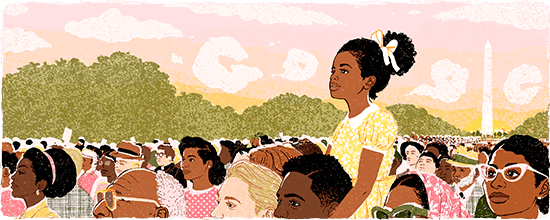





 BEAUTIFUL, ALSO, ARE THE SOULS OF MY BLACK SISTERS